Journal Paper
Large language model agent for user-friendly chemical process simulations
Jingkang Liang, Niklas Groll, Gürkan Sin
Abstract
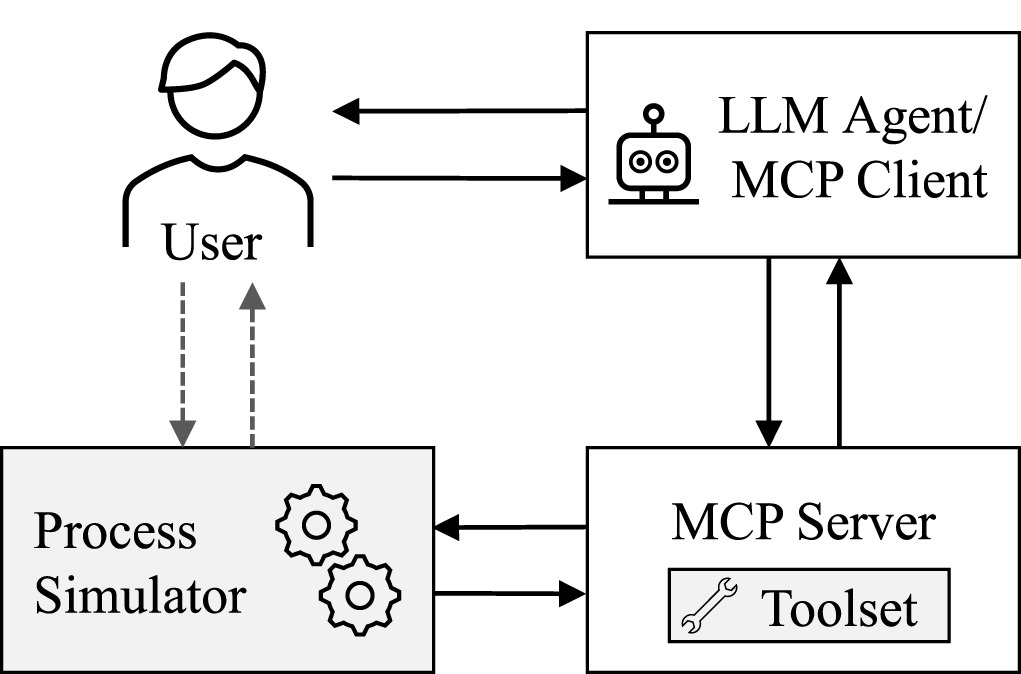
Modern process simulators enable detailed process design, simulation, and optimization; however, constructing and interpreting simulations is time-consuming and requires expert knowledge. This limits early exploration by inexperienced users. To address this, a large language model (LLM) agent is integrated with AVEVA Process Simulation (APS) via Model Context Protocol (MCP), allowing natural language interaction with rigorous process simulations. An MCP server toolset enables the LLM to communicate programmatically with APS using Python, allowing it to execute complex simulation tasks from plain-language instructions. Three case studies assess the framework across different task complexities and interaction modes. The first shows the agent autonomously analyzing flowsheets, finding improvement opportunities, and iteratively optimizing, extracting data, and presenting results clearly. The framework benefits both novice users (for educational purposes), by translating technical concepts and demonstrating workflows, and experienced practitioners, by automating data extraction, speeding routine tasks, and supporting brainstorming. The next case study assesses autonomous flowsheet synthesis through both a step-by-step dialogue and a single prompt, demonstrating its potential for novices and experts alike. The step-by-step mode gives reliable, guided construction suitable for educational contexts; the single-prompt mode constructs fast baseline flowsheets for later refinement. Further, the agent’s answers proved stable across variations in LLM versions, prompting types, and process flowsheet complexities. While current limitations mainly involve the accurate interpretation of the physical results seen in minor reasoning mistakes, such as oversimplification or misleading suggestions, mean expert oversight is still needed. However, the framework’s capabilities in analysis, optimization, and guided construction suggest LLM-based agents can become valuable collaborators for process simulation tasks in future.